
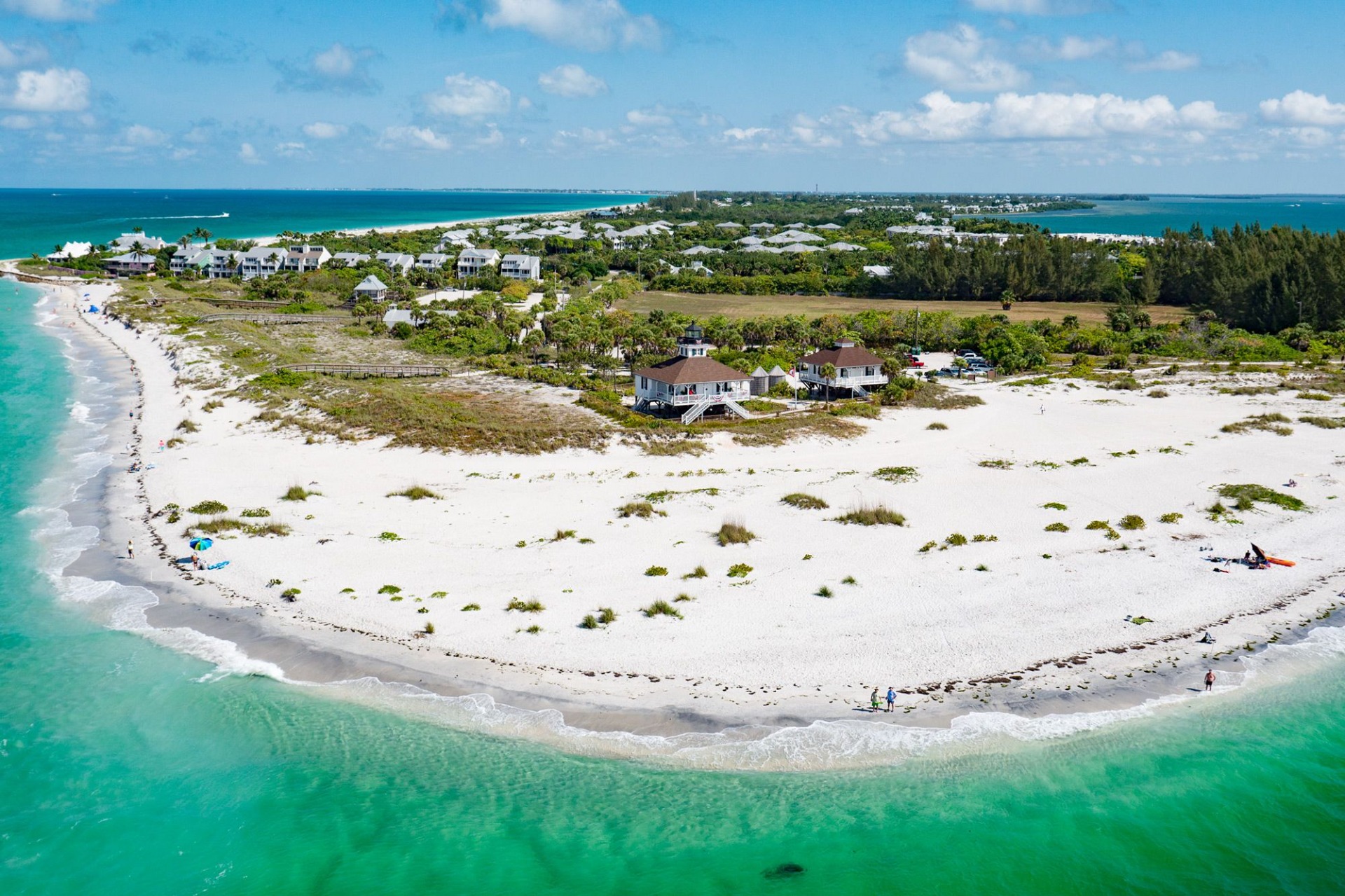
Open fires on Gasparilla Island beaches are not something visitors can simply start on their own. Florida state park beaches — including Gasparilla Island State Park — prohibit ground fires except in designated facilities, and Lee County beach regulations restrict open flame and require authorization from the local fire authority for any permitted beach fire. Because Gasparilla Island is also a nesting beach where artificial light after dark is regulated during sea turtle season, most families skip the fire entirely and plan a low-light sunset picnic instead. Always confirm current rules with the Florida Park Service, Lee County Parks & Recreation, and the local fire district before planning anything involving flame.
Every season a family asks us some version of the same question: "Can we do a bonfire on the beach one night?" It's a fair thing to want. A driftwood fire on the sand is one of those pictures people carry around in their heads long before they book a trip. But on Gasparilla Island, the honest answer is not the one most people are hoping for.
We're not going to give you a confident-sounding permit number or a fee we haven't verified. What we can give you, after eighteen years of hosting families on this coast, is an accurate picture of how the rules are structured, why they exist here specifically, and the sunset evening that actually works — the one our guests end up loving more than the fire they originally asked about.
So, Can You Have a Beach Fire on Gasparilla Island?
Not on a whim, and in most of the places you'd want one, not at all. Two separate layers of rules apply depending on where your feet are standing.
On the state park end of the island, Florida Park Service rules prohibit ground fires anywhere except in facilities the park provides for that purpose. Gasparilla Island State Park's beachfront is a day-use, natural-shoreline park — it is not a campground with fire rings. There is no self-serve fire option there.
On county-regulated beach and shoreline areas, Lee County's beach and park regulations restrict open flame, and any beach fire that is allowed at all requires prior authorization from the fire authority with jurisdiction. That's a permitting process handled in advance by the local fire district and county — not a decision a visitor, a rental host, or a beach club employee can make on the spot.
If you're still in the planning stage of your trip, it's worth reading our complete family guide to Gasparilla Island State Park first, because the park's boundaries determine which of those two rule sets you're under at any given stretch of sand.
On this island, the rule isn't "no fun after dark" — it's "no open flame you didn't get permission for."
Why This Island Is Stricter Than You'd Expect
It helps to know that these aren't arbitrary rules written to spoil an evening. Gasparilla Island sits on a stretch of Gulf coast that is genuinely important nesting habitat, and nearly every beach regulation here traces back to that.
Florida's Gulf beaches host loggerhead sea turtle nesting on a scale that matters globally — Florida beaches account for the large majority of loggerhead nesting in the United States. Nesting females come ashore at night. Hatchlings emerge at night. Both orient themselves using the natural brightness of the open horizon over the water, and both are pulled off course by artificial light landward of them.
A fire is a large, moving, landward light source sitting directly on the nesting zone. Add the leftover char, the nails and staples in scrap pallet wood people burn, the hot sand that stays hot for hours after the flames are out, and the buried coals that a barefoot kid finds the next morning — and the reasoning behind the restriction stops feeling bureaucratic.
Where Visitors Usually Get This Wrong
Most of the confusion we hear falls into a handful of predictable patterns. Knowing them saves you a frustrating conversation with a park ranger or a deputy.
- "My friend did it in the Panhandle." Rules vary enormously by county and municipality in Florida. What a permit office in one coastal county allows says nothing about what's allowed here.
- "It's a small fire in a portable pit, so it doesn't count." A contained fire is still an open flame and still a light source. Containment may matter for approval; it does not create an exemption on its own.
- "The house is right on the water, so it's private beach." Below the mean high water line, Florida's sandy shore is generally held in public trust — and the state and county regulations that govern it apply regardless of whose home is behind you.
- "We'll just use charcoal in a grill." Grilling rules and open-fire rules are different regulations, and a park or beach that prohibits both is common. Confirm before you haul a grill onto the sand.
- "Nobody's out there at night anyway." On a nesting beach in summer, that's precisely the point.
The Sunset Evening That Actually Works Here
Here's the part worth reading. The fire is usually a proxy for something else — the family staying out past the normal turnaround time, everyone facing the same direction, no screens. You can have all of that without a flame, and honestly it goes better.
- Arrive well before sunset, not at sunset. The color show on the Gulf keeps going after the sun is down, and the best light for photos of your kids is in the twenty minutes before it drops.
- Bring the meal already made. Sandwiches, cut fruit, something in a thermos. Cooking on the beach is where the rules get complicated; eating on the beach is where the evening gets good.
- Use battery lanterns with warm amber or red light, kept low and shielded. Amber and red wavelengths are far less disruptive to nesting turtles and hatchlings than white or blue-white light, which is why turtle-friendly lighting is the coastal standard.
- Set up a real base. A blanket, low chairs, and a windbreak of some kind. Gulf breeze after dark is cooler than families expect, especially in the shoulder seasons.
- Bring layers even in summer. Damp swimsuits plus evening breeze is the single most common reason a beach evening ends early.
- Plan the exit. Know where you parked and how you're rinsing feet before anyone gets sleepy. This one detail is the difference between a great memory and a rough drive back.
We wrote a whole separate piece on timing this well — how to catch a great Boca Grande sunset without the meltdown — because the logistics matter more than the location does.
What to Actually Pack for a Sunset Beach Evening
This is the list we'd hand a family walking out our door for the evening. Nothing exotic, and every item earns its place.
- Amber or red LED lanterns and headlamps — not your phone flashlight, which is the exact wrong color and the exact wrong height
- A packable blanket plus one old towel you don't mind losing to the sand
- Insulated bottles — the beach is warmer than you think until suddenly it isn't
- A trash bag and a second bag for wet things, both bigger than you think you need
- Long sleeves or a light hoodie per person, even in August
- Bug protection for the low-wind evenings, especially near mangrove edges and after rain
- A hard-sided container for anything crushable, because everything on a beach eventually gets sat on
If your evening involves anyone going into the water before the sun drops, read our field guide to rip currents and beach safety first. Low light and swimming are a combination we'd steer any family away from.
How to Leave the Sand Better Than You Found It
The reason beaches lose privileges is almost never one dramatic incident. It's the slow accumulation of small, ordinary carelessness. A few habits keep this simple.
- Fill in every hole you dug before you leave. An open hole is a hazard for people walking at night and a genuine trap for nesting turtles and hatchlings.
- Flatten sandcastles and remove anything you built with. It's counterintuitive, but a wall of packed sand is an obstacle to something crawling toward the water.
- Take every chair, umbrella, tent, and toy off the beach at the end of the day. Leaving gear overnight on a nesting beach is prohibited in many Florida coastal communities for exactly this reason.
- Do a deliberate sweep with a light before you go — bottle caps, wrappers, the corner you tore off a snack bag. Sit down and look at the sand from ground level.
- Never move or shine light on a nesting turtle or hatchlings. Watch quietly from a distance and report anything in distress to the appropriate wildlife authority.
- Keep dune vegetation alone. Sea oats and the roots under them are what hold the shoreline in place.
Planning the Evening From a Home Base Nearby
A sunset beach evening is much easier when you're not driving an hour each way with tired kids. Staying close to the coast means you can go out at the right hour, come back to rinse off, and let the day end gently instead of in a car. Our Seaside Boca home is set up for exactly that kind of evening — the kind where you take the picnic out, come back sandy, and nobody has to be heroic about it.
And if you do want a genuine fire on your trip, the honest path is to have it at your accommodation, in a fixed outdoor fireplace or fire feature that already exists there, on a night with no burn ban in effect — not on the sand. That's the version that's actually allowed, actually safe, and doesn't require anyone to look the other way.
How to Confirm the Current Rules Before You Go
Fire regulations are among the most changeable rules in coastal Florida. Drought conditions trigger burn bans. Nesting season shifts lighting enforcement. Ordinances get updated. Do not take any blog post — including this one — as your final authority.
- For the state park portion of the island: contact the Florida Park Service or the Gasparilla Island State Park office directly.
- For county beach and park areas: check with Lee County Parks & Recreation for current beach regulations.
- For anything involving flame: the local fire district with jurisdiction is the authority on permits and on whether a burn ban is currently in effect.
- For sea turtle lighting rules and current nesting-season dates: the Florida Fish and Wildlife Conservation Commission is the primary source.
- For your specific rental: ask your host what is and isn't permitted on that property before you arrive with equipment.
One phone call in advance is worth more than an afternoon of searching. And in our experience, the ranger or fire district staffer on the other end is genuinely helpful when the question is asked before the fact rather than explained after it.
Beach Fire Questions Families Actually Ask on Gasparilla Island
Are beach bonfires legal on Boca Grande?
Not as a walk-up activity. Florida state park rules prohibit ground fires outside of designated facilities, and Gasparilla Island State Park's beach has no fire rings. On county-regulated shoreline, any beach fire requires advance authorization from the fire authority with jurisdiction. Confirm current requirements with the county and local fire district before planning one.
Can I use a portable fire pit or propane fire bowl on the sand?
Don't assume containment makes it allowed. A contained fire is still an open flame and still a light source on a nesting beach, and portable devices are generally covered by the same restrictions. Check directly with the managing authority for that stretch of beach before bringing anything that produces flame.
Why does sea turtle nesting affect what I can do on the beach at night?
Nesting females and hatchlings both move at night and orient toward the natural brightness over the open water. Artificial light behind them — including firelight — can pull them the wrong direction. Florida's nesting season generally runs from about May through October, and coastal communities enforce beach lighting rules during that period.
What kind of light can we use on the beach after dark?
Amber or red LED lights, kept low and shielded so the beam points down rather than out. These wavelengths are far less disruptive to nesting turtles than the white or blue-white light from phone flashlights and standard lanterns. This is the standard coastal Florida communities use for turtle-friendly lighting.
Can we grill on the beach instead of having a fire?
Grilling and open fires are governed by different rules, and many beaches and parks restrict both. Never assume that charcoal or a portable grill is exempt from a fire restriction. Ask the park or county office about that specific beach before you carry equipment out.
What's the single most important thing to do before leaving the beach at night?
Fill in every hole you dug and take all your gear with you. Open holes and leftover chairs, tents, and umbrellas are genuine hazards to nesting turtles and hatchlings, and to people walking in low light. A quick sweep with a light before you go catches the rest.

Travel DRD - Free Land Vacations — IATA certified, IATAN and ASTA members, hosting families since 2007. We manage every home in this collection ourselves.
Last updated: August 23, 2026