
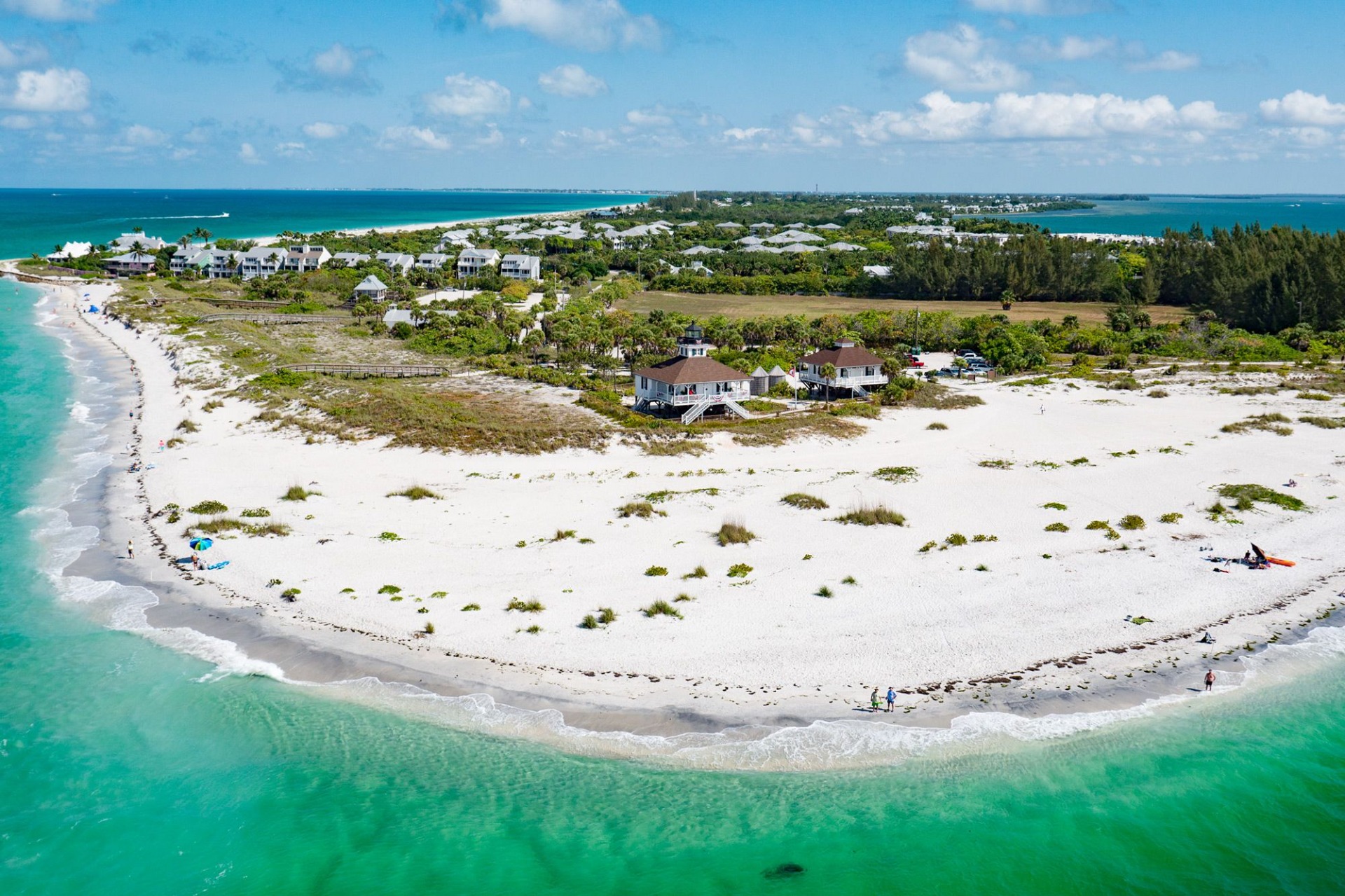
A disrupted Boca Grande beach week usually doesn't need to be canceled — it needs to be re-ordered. Read the multi-day forecast for wind direction and speed, rain timing, and storm coverage rather than the daily icon, then assign beach and boat activities to the calmest, clearest windows and move indoor or inland plans to the rough days. In Southwest Florida's warm months, rain often arrives as afternoon storms, which means mornings are frequently usable even on days that look bad at a glance.
Almost every family who books a Gulf-side week eventually hits the same moment: it's Sunday night, the week is planned, and the forecast for Tuesday through Thursday turns into a row of gray icons. The instinct is to feel like the trip is ruined. After eighteen years of hosting guests on this coast, we can tell you it usually isn't. What's actually happened is that the good hours moved.
Southwest Florida weather is less like a wall and more like traffic. It comes through in patterns, with gaps. The families who have the best weeks aren't the ones who got the clearest forecast — they're the ones who looked at the whole week at once, found the gaps, and put the beach and boat days there instead of where the calendar originally said.
Stop reading the daily icon and start reading the hours
A single icon has to summarize twenty-four hours in one picture, so it defaults to the worst thing that happens. A day with a bright, calm morning and one thunderstorm at four in the afternoon gets the same storm icon as a day of steady rain from dawn to dusk. Those are completely different days for a family with beach chairs in the car.
Open the hourly view instead. You're looking for three things, in this order:
- Wind speed and direction, hour by hour. This decides whether the Gulf is swimmable and whether a boat day is pleasant or miserable.
- Timing of rain, not just whether rain appears. A 60 percent chance concentrated between 3 and 7 p.m. leaves a very usable morning.
- Coverage language in the forecast discussion — words like isolated, scattered, and widespread describe how much of the area gets hit, which matters enormously on a peninsula.
The National Weather Service forecast discussion for the Tampa Bay area office, which covers this stretch of coast, is written in plain language by a meteorologist and explains the reasoning behind the numbers. It's the single most useful free thing most visitors never open.
Wind is the variable that decides your week, not rain
Rain here is often brief. Wind is not. A sustained onshore wind stirs up the Gulf, reduces water clarity, pushes chop into the passes, and makes an afternoon on a boat feel like a chore rather than a treat. A light offshore or calm morning does the opposite — flat water, clearer visibility, easy anchoring.
When we look at a guest's week, wind is the first filter. If two days are calm and three are breezy, the calm days get the beach and the boat regardless of what anyone planned. Everything else is negotiable.
You don't cancel a beach week because of weather — you re-order it.
Build a swap list before you need it
The reason re-sequencing fails is almost never the forecast. It's that nobody knows what to do instead, so a canceled beach morning turns into three hours of scrolling and arguing about lunch. The fix is to build a short swap list on the first night of the trip, while everyone is still cheerful.
Write down four or five activities that don't depend on weather at all, and four or five that specifically need good conditions. Then you're not inventing a plan under pressure — you're just pulling from a list.
- Needs good conditions: beach day, boat or charter day, shelling at low tide, kayaking, long bike ride, sunset on the sand.
- Weather-independent: museums and small-town browsing, aquarium or nature center, a long lunch somewhere with a view, a movie, indoor games at the house, a drive inland where the storm pattern is different.
We wrote a full version of the second half of that list in our Boca Grande rainy-day plan, which is worth skimming before you arrive so you're not searching for ideas with four wet kids in the living room.
Four rules for re-sequencing a week
Once you know which days are usable, the rebuild is mostly mechanical. These are the rules we give guests who call us on a Monday asking what to do.
- Protect the best window first. Find the calmest, clearest half-day in the whole forecast and assign your highest-value activity to it — usually the boat day or the one beach day everyone has been talking about. Build everything else around that anchor.
- Move outdoor plans earlier, not later. If a day looks marginal, start it at sunrise rather than waiting to see what happens. The window you're hoping for in the afternoon is usually the one that closes.
- Never stack two weather-dependent plans on the same day. If the boat and the beach both land on Wednesday, you've put two eggs in one basket for no reason. Spread them.
- Keep one flexible day untouched. Don't schedule anything on it. That's the day you'll need when something shifts, and every re-sequenced week needs somewhere to put the overflow.
What to do about things you already booked
Charters, guided trips, and rentals are the hard part, because they're the things you can't freely move. Handle them at the time of booking, not the day of.
When you reserve anything on the water, ask two specific questions: what their weather cancellation policy is, and how much notice they need to reschedule. Operators here deal with this constantly and most have a sensible policy, but the terms vary a great deal between businesses, so get the answer for yours in writing. Also ask who makes the call and when — a captain deciding at 6 a.m. is very different from a company that decides the night before.
Then, if the forecast starts trending badly two or three days out, call early. The families who get the good rescheduled slot are the ones who called Monday about a Thursday trip, not the ones who called Thursday morning.
How season changes the whole calculation
The re-sequencing framework is the same year-round, but what you're re-sequencing around changes completely. In the warm months, the pattern is daily and predictable in shape: clear mornings, building heat, afternoon storms that often clear by evening. You're working around a few hours. In the cooler months, disruption more often comes from a front pushing through — a stretch of wind and cooler air that can sit over the area for a couple of days and doesn't care what time it is.
That difference matters at the booking stage as much as the planning stage, and it's the main reason we put together a season-by-season guide for families. If you're booking inside the official Atlantic hurricane season, which runs from June 1 through November 30, the calculation includes your money as well as your calendar — our guide to booking during hurricane season covers what actually protects a deposit and what doesn't.
Where you stay changes how much a bad day costs
This is the part most planning advice skips. A rough weather day is a very different experience depending on the house you're sitting in. A place with one small common room and no covered outdoor space turns a three-hour storm into a genuine problem. A house with a screened porch, room to spread out, and a kitchen you actually want to cook in absorbs the same three hours without anyone noticing.
When guests ask us how to weather-proof a trip, the honest answer starts with the rental, not the forecast. We built Seaside Boca with exactly this in mind — space that works when everyone is inside, and a short walk to the sand when the window opens back up. The best re-sequencing plan in the world still needs somewhere comfortable to wait.
The honest part: sometimes a day is just lost
We're not going to tell you every week can be saved. Occasionally a system parks over the region and you get two days of real, all-day rain with nothing usable in them. That happens. But in our experience it's rare, and it's far more common that a family writes off a week that actually had six or seven perfectly good beach hours in it — they just weren't where the plan said they'd be.
Check the hourly forecast every evening for the following day and adjust once. Not five times a day, which only makes everyone anxious. Once, after dinner, with the swap list in front of you. That's the whole system.
Common questions about weather-proofing a Boca Grande week
Is it worth going to the beach on a day with a high chance of rain?
Often, yes — if the rain is forecast for the afternoon. Check the hourly breakdown rather than the daily percentage. In the warm months, storms here commonly build with the afternoon heat, which leaves the morning clear and calm. Go early, watch the sky, and be willing to leave.
How far ahead can I actually trust a Southwest Florida forecast?
The general pattern — whether the week trends stormy or settled — is usually reasonable several days out. The specific timing of any individual storm is not reliable more than about a day or two ahead. Use the long view for sequencing your week and the short view for deciding what to do tomorrow.
Should I move my boat day if the forecast looks uncertain?
Move it toward the calmest wind in the forecast, not simply away from rain. Wind has a much bigger effect on comfort and safety on the water than a brief shower does. Also call the operator early rather than waiting, since rescheduled slots fill quickly when weather turns.
What's the single most useful forecast source for this area?
The National Weather Service office covering the Tampa Bay region publishes both hourly data and a written forecast discussion explaining the reasoning. The discussion tells you whether storms are expected to be isolated or widespread, which is the detail that determines whether your specific stretch of coast gets hit.
How many activities should I plan per day on a beach week?
One anchor activity per day, plus a flexible backup. Families who plan two or three fixed things a day have no room to absorb a change, and a single weather shift collapses the whole schedule. Leaving at least one full day completely unscheduled gives you somewhere to move things.
Does a rainy forecast mean I should cancel or rebook my trip?
Rarely. Standard rain and storms almost never make a week unusable, and most cancellation policies won't cover ordinary weather anyway. Rebooking is a reasonable conversation for a named storm with an official evacuation order — not for a forecast with storm icons on it.

Travel DRD - Free Land Vacations — IATA certified, IATAN and ASTA members, hosting families since 2007. We manage every home in this collection ourselves.
Last updated: September 17, 2026