
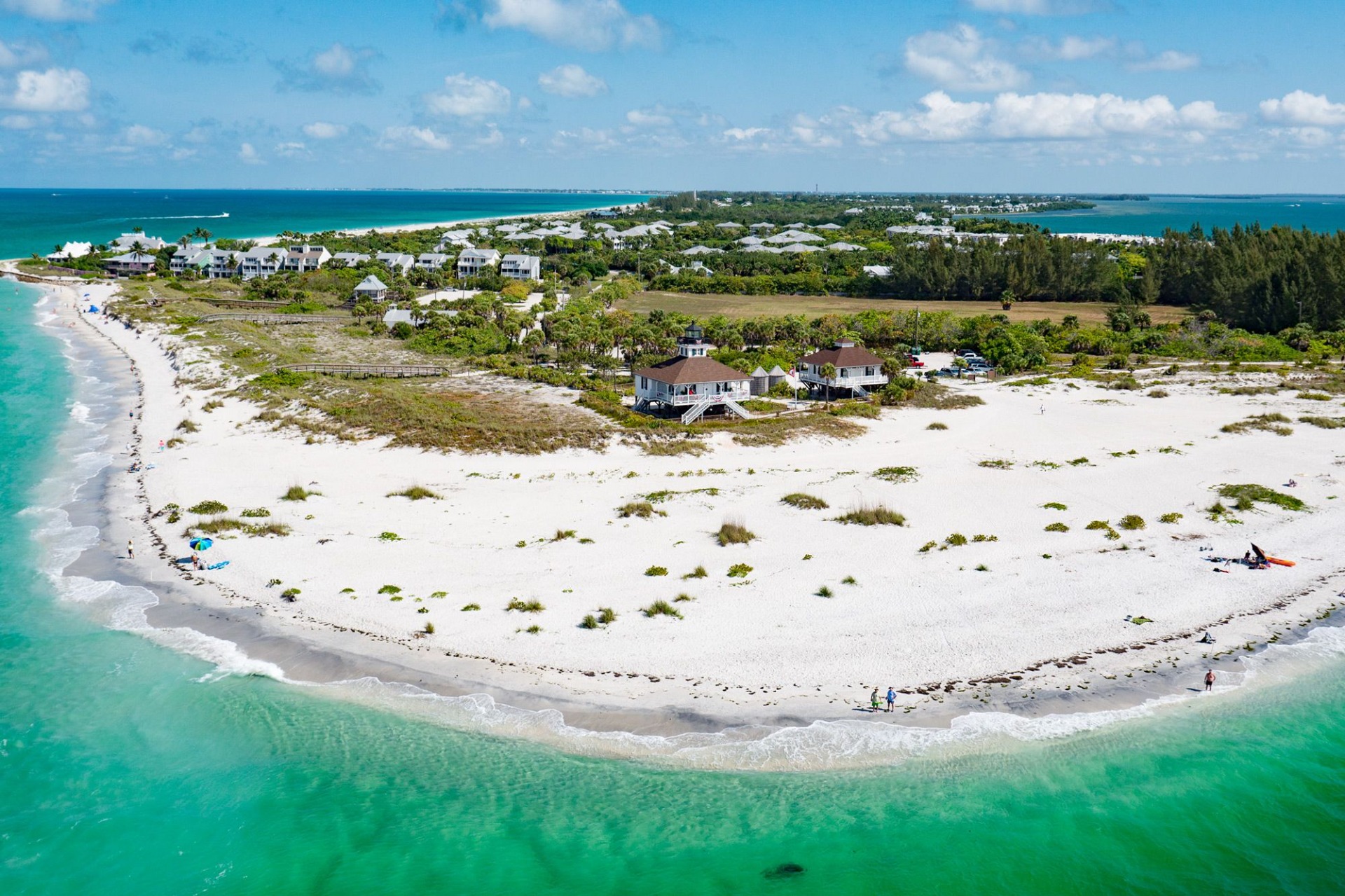
Sea turtle nesting season in Southwest Florida runs roughly May 1 through October 31, and Gasparilla Island beaches are surveyed each morning by permitted volunteers who mark nests with stakes and tape. Families staying in beachfront rentals should keep beach-facing lights off or shielded after dark, use amber or red-filtered flashlights, and fill in holes and remove chairs before sunset. Hatchlings find the water by moving toward the brightest, lowest horizon, so artificial light from a porch or phone screen can pull them inland. Never touch a nest, a marker, or a hatchling; report anything that looks wrong to the local sea turtle patrol or FWC.
If you visit Boca Grande between May and October, you'll notice something on the beach that isn't there in February: short wooden stakes with orange or yellow tape, set back near the dune line, each one marking a spot where a female sea turtle came ashore at night and buried a clutch of eggs. Some mornings there's one. Some mornings there's a line of them stretching down the sand.
Guests sometimes ask us whether nesting season ruins a beach vacation. It doesn't. It changes it — mostly in small, easy ways — and honestly it's one of the better things about a summer stay here. Our family has been hosting on this coast for 18 years, and the questions repeat every June, so here's the plain version.
When is sea turtle nesting season on Gasparilla Island?
Florida's sea turtle nesting season is generally observed from May 1 through October 31, with the heaviest nesting on the Gulf coast in June and July and most hatching from midsummer into fall. Loggerheads are the species you'll encounter most often on this stretch of coast; green turtles nest here in smaller numbers.
Practically, that means an early-June stay is nesting season — you'll see fresh crawls and new nests. An August or September stay is hatching season, when the nests laid earlier start to boil out at night. Both are worth planning around, just differently.
What do the stakes and tape on the beach actually mean?
Permitted volunteers and staff walk the beach at sunrise looking for crawls — the tractor-tread tracks a nesting female leaves coming up and going back. When they confirm eggs, they mark the nest, record it, and leave it alone. The stakes are a boundary, not decoration. Some nests also get a wire screen over them to discourage raccoons and other diggers.
A few things that surprise people:
- A marked nest can sit quiet for roughly two months before anything happens. Nothing is wrong with it.
- Not every crawl produces a nest. Turtles sometimes come up, change their minds, and go back — those are recorded too.
- The stakes aren't always right where the eggs are; they're offset. Walking "just inside" the tape is still walking on the nest.
- Only permitted people may touch a nest or its markers. That includes moving a stake that's "in the way" of your chairs. Move the chairs instead.
The tape isn't a suggestion — it's the only thing standing between a beach chair and a hundred eggs.
Why lights-out rules matter so much in a beachfront rental
This is the part that involves you directly, and it's the single most useful thing a visiting family can get right. Hatchlings emerge at night and orient toward the brightest, lowest horizon — which, on an undeveloped beach, is the open water reflecting the night sky. A lit porch, an open slider throwing light across the sand, a floodlight on a walkover, or a phone screen held up to film can be brighter than the water. The hatchlings turn the wrong way, head inland, and don't make it.
Nesting females get disorienting light too. A brightly lit beach can turn a female around before she ever digs, which is why coastal towns along this shore take lighting seriously enough to write it into ordinance.
So when you're staying anywhere near the sand — including a Boca Grande home like Seaside Boca — the routine is simple: after dark, close beach-facing blinds, turn off exterior lights that spill toward the water, and skip the string lights on the deck. It costs you nothing and it's the difference between a nest that works and one that doesn't.
Can we still walk the beach at night? What kind of flashlight?
Yes — night beach walks are one of the best parts of a summer stay here, and they're allowed. The rule is what you carry. White light is the problem; long-wavelength amber or red light is far less disruptive to hatchlings and nesting females.
- Bring a flashlight or headlamp with a true red or amber mode, or tape red filter film over a white one. Pack it before you come — the good ones sell out locally in summer.
- Keep the beam pointed down at your feet, never out toward the water or up along the dune line.
- Turn off phone flashlights entirely. A phone screen at full brightness carries farther on a dark beach than people expect.
- No flash photography, no video lights, no drones after dark.
- Walk on the wet, packed sand near the water rather than up by the dunes where nests are.
Same footwear-and-footing common sense applies at night as in daylight — worth reading our beach safety field guide before your first evening walk, especially if you're bringing kids out after dark.
How do you watch a nest hatch without hurting it?
First, honest expectations: most hatches happen late at night, fast, and without an audience. Families who go looking for one usually don't find one. Families who happen to be walking the beach at the right moment sometimes do. Don't build a vacation around it — build a vacation that's ready for it.
If you do come across hatchlings moving down the sand:
- Stop where you are and stay back. Give them a wide, open path to the water — don't stand between them and the Gulf.
- No lights at all, red included, once they're actively crawling. Let your eyes adjust instead.
- Don't pick them up, don't carry them to the water, don't clear their path or dig them out. That crawl matters to them physiologically; it isn't just travel.
- Keep dogs and kids still and quiet. This is a good moment to sit down in the sand together.
- If hatchlings are clearly headed inland, toward a road or a lit building, don't intervene — note the location and call the local sea turtle patrol or FWC's wildlife hotline.
The other thing worth saying: watching an adult female nest is a different situation entirely, and the answer is stay away. A disturbed female will abandon the attempt. If you see a large turtle coming ashore, back off quietly and give her the beach.
How does nesting season change an ordinary beach day?
Less than you'd think. Daytime swimming, shelling, and sandcastles are unaffected. What changes is what you leave behind at the end of the day.
| Off-season habit | Nesting season habit | |
|---|---|---|
| Chairs & umbrellas | Leave them out overnight | Off the beach before sunset |
| Sandcastles & holes | Leave them | Knock down and fill in |
| Evening lighting | Porch lights on | Beach-facing lights off or shielded |
| Flashlights | Any light | Red or amber only |
| Walking route | Anywhere | Wet sand, away from dune line |
The holes matter more than people expect. A knee-deep hole left in the sand is a trap for a hatchling crawling to the water and for an adult female coming ashore, and it's a trap for the volunteer walking the beach at 6 a.m. too. Fill it in — it takes thirty seconds and it's a decent chore to hand a kid.
Furniture left overnight blocks crawl paths and can turn a nesting attempt back. Most rentals here have a place to stack chairs; use it.
How do you make this interesting for kids instead of a list of rules?
Give them a job. Our guests' kids do best when turtle season becomes their assignment rather than a set of restrictions: hole-filling patrol before dinner, spotting fresh crawls on the morning walk, counting how many new nests appeared overnight, being the one who checks that the deck lights are off. A morning walk right at sunrise is the single best activity of the whole trip for this — the crawls are fresh and undisturbed, and it pairs well with the trails and beaches covered in our Gasparilla Island State Park guide.
With very small kids, keep the night portion short and the daytime portion normal — the same pacing that makes any Boca Grande beach day work with a toddler, which we walk through in our toddler beach day guide.
Kids who are given a job on the beach protect it better than kids who are given a rule.
Who do you call if something looks wrong?
If you find a hatchling in a parking lot, a turtle that appears injured or stranded, a disturbed or vandalized nest, or hatchlings heading toward lights, don't handle it yourself. Call the Florida Fish and Wildlife Conservation Commission's wildlife alert line or the local sea turtle patrol organization that surveys Gasparilla Island. Note the nearest beach access point or cross street so responders can find the spot fast.
And a small honest note from the host side: none of this is about being precious. Sea turtles are protected under federal and state law, and the lighting and nest rules are enforceable. But the reason we hand every summer guest a red flashlight isn't the law. It's that a family who gets this right gets to be part of something that's been happening on this island a great deal longer than any of us have been renting houses on it.
Turtle Season Questions Our Guests Actually Ask
Are we allowed on the beach at night during turtle nesting season?
Yes — public beach access at night is generally permitted, and night walks are a great part of a summer stay. What's restricted is light and disturbance: use amber or red flashlights only, keep beams pointed down, skip flash photography and drones, and stay off the dune line where nests are marked.
What happens if we accidentally disturb a marked nest?
Don't try to fix it yourself — repositioning stakes or sand can do more harm. Note the location and report it to the local sea turtle patrol or FWC so a permitted responder can assess it. Sea turtles and their nests are protected under state and federal law, so genuine tampering carries real penalties, but an honest report is always the right move.
How long after a nest is laid does it hatch?
Loggerhead nests typically incubate for roughly two months before hatchlings emerge, though timing varies with sand temperature. That's why a nest marked in early June may not do anything until August. A quiet, undisturbed nest is a normal nest.
Do we really have to turn off the porch lights every night?
If your rental faces the beach, yes — that's the single highest-impact thing a guest can do. Hatchlings orient toward the brightest low horizon, and a lit deck can pull an entire nest inland away from the water. Close beach-facing blinds, shut off exterior lights that spill toward the sand, and skip decorative string lights after dark.
Can we take pictures if we see hatchlings?
No flash, no video light, and no phone flashlight. Those are exactly the artificial light sources that disorient hatchlings. If there's enough moonlight for a photo without any added light, that's fine — otherwise, put the phone away and just watch it.
Is a summer stay in Boca Grande worth it with all these rules?
We think it's the best time to be here. The rules amount to filling in holes, stacking chairs before sunset, keeping beach-facing lights off, and carrying a red flashlight. In exchange you get warm water, quieter beaches than winter, and a genuine chance of walking up on a hatch.

Travel DRD - Free Land Vacations — IATA certified, IATAN and ASTA members, hosting families since 2007. We manage every home in this collection ourselves.
Last updated: August 25, 2026