
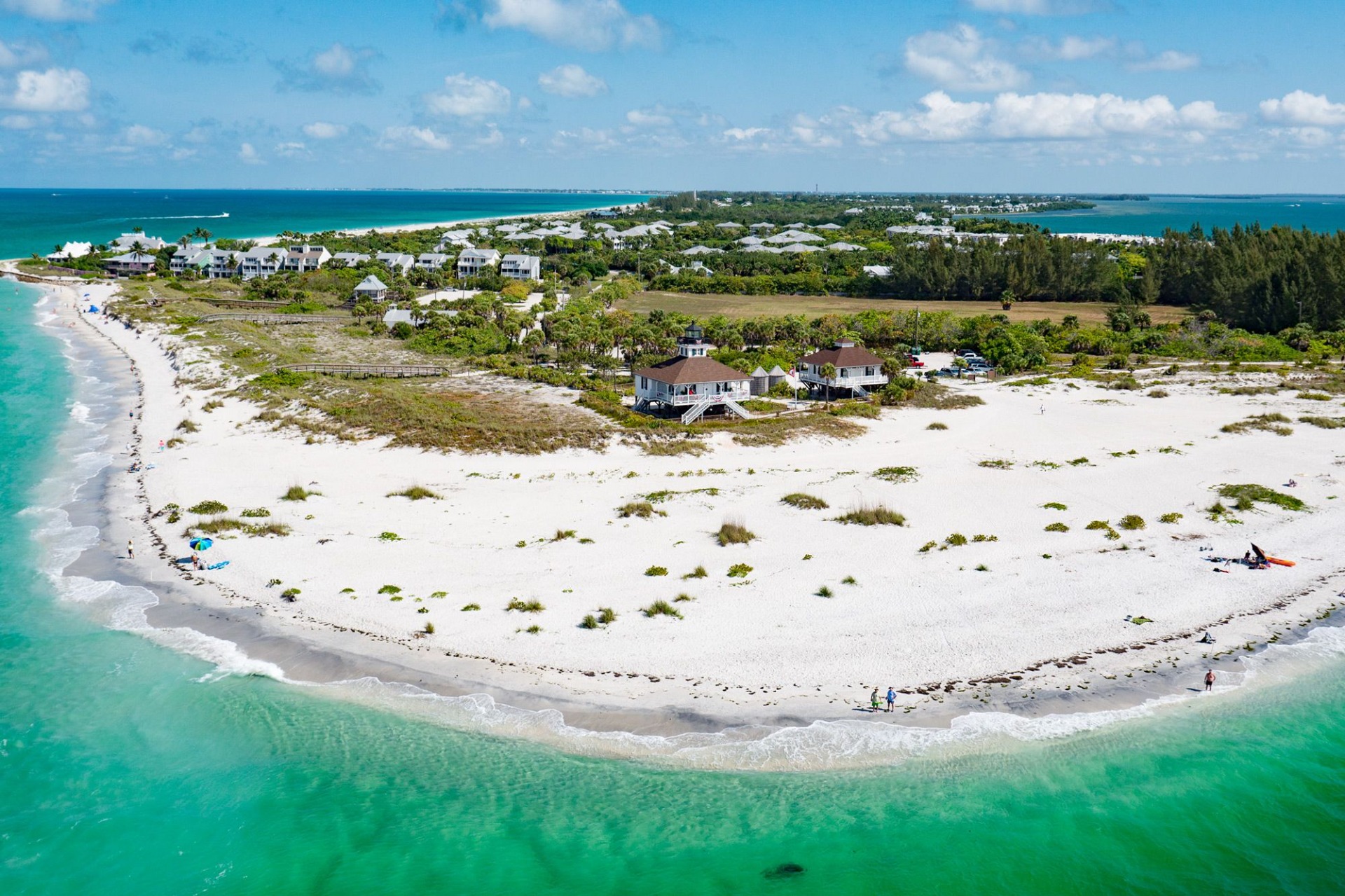
Gasparilla Island's Gulf beaches are open sand with very little natural shade, so families need to bring their own. A sand-auger umbrella anchor, an umbrella tilted into the wind, and a morning-or-late-afternoon beach window handle most of it. Lee County beach parks generally restrict large staked canopies and tents during sea turtle nesting season and require gear to be removed nightly, so confirm the current rules for your specific beach access before you haul a canopy out.
The first thing most families notice when they step over the dune line on Gasparilla Island is how bright it is. There are no cliffs, no pine canopy, and almost no trees close enough to the water to matter. The sea grape and cabbage palm sit back behind the dune, and the sand in front of you runs flat and pale straight to the Gulf. It is beautiful, and it is completely exposed.
After eighteen years of getting families out the door and back again, the pattern we see is simple: the beach days that go badly are almost never about the water. They are about a two-year-old who got too hot by eleven, or an umbrella that went cartwheeling down the sand at the first real gust. Both are fixable, and neither requires buying much.
Why is there so little shade on Boca Grande's beaches?
Gasparilla Island is a barrier island — a narrow strip of sand between the Gulf of Mexico and Charlotte Harbor. The vegetation that can survive on the seaward side is low, salt-tolerant scrub, not shade trees. What canopy exists sits behind the primary dune, which is protected and not somewhere you set up a towel. So the shade you get at the waterline is the shade you carried down there.
That is different from a lot of Florida beaches families have in their heads. It also means the reflected light is doubled: sand and water both bounce it back up, so kids catch sun on the underside of the chin and the backs of the knees even while sitting under an umbrella. Sunscreen still goes on under the shade.
On a barrier island, shade is luggage — if you didn't carry it down, it isn't there.
How do you keep a beach umbrella from blowing away in soft sand?
Pushing a straight pole into dry sand and hoping is how umbrellas become other people's problem. Gasparilla sand near the dune line is loose and fine, and the Gulf sea breeze builds through the day as the land heats up — so an umbrella that felt solid at nine can be airborne by one o'clock.
What actually works, in order of how much difference it makes:
- Use a sand auger — the corkscrew-style anchor you twist down into the sand and drop the pole into. It grips far better than a straight shaft because the threads engage a whole column of sand instead of one narrow hole.
- Set up on damp sand where you can, closer to the tide line but above the wrack line. Damp sand holds an anchor dramatically better than dry powder.
- Tilt the umbrella INTO the wind, not away from it. A canopy tipped toward the breeze sheds it. A canopy tipped away from the breeze becomes a parachute.
- Choose a vented umbrella — the ones with a flap at the top that lets air pass through instead of loading the whole dome.
- Pile sand or set a loaded cooler bag against the base as a last line of defense.
If a strong steady onshore wind is running, the honest answer is sometimes to leave the umbrella down and use a low beach shelter or a pop-up sun shade that sits close to the ground instead. Low profile beats tall in wind every time. We cover the rest of the gear question in our packing list for a bike or golf cart beach day, which is written around exactly this constraint.
Are pop-up canopies and tents allowed on the beaches here?
This is the question we get most, and it deserves a careful answer rather than a confident one. Beach shade structures in this part of Florida are governed by a mix of county park rules and sea turtle protection requirements, and they are not uniform from one access point to the next.
The general principles that hold across the area: large staked tents and canopies are frequently restricted or prohibited on public beach areas, umbrellas and small low shade shelters are usually the accepted alternative, and during sea turtle nesting season all beach equipment is expected to be removed from the beach at the end of the day so hatchlings and nesting females are not obstructed. Digging holes and leaving them open overnight is also discouraged for the same reason — they trap hatchlings and, honestly, ankles.
Because the specifics differ by beach and get updated, check the posted signage at the access you are using and the current Lee County parks and beaches guidance before you plan around a full canopy. Bringing a good umbrella and a low shelter is the setup that is welcome nearly everywhere and is far easier to move when the sun shifts.
What time of day should families actually be on the beach?
Timing does more for a family beach day than any piece of equipment. The sun is highest and the ultraviolet load is heaviest through the middle of the day — roughly late morning to mid-afternoon — and that is also when the sand gets hot enough to hurt bare feet and when the sea breeze is usually strongest.
The rhythm that works for guest families with young kids:
- Early morning: coolest sand, calmest water, gentlest light, and the best shelling. This is the window if you have a toddler.
- Late morning: still good, but start watching for flushed cheeks and the kid who has stopped talking. That is usually heat, not mood.
- Midday: go back. Lunch, a nap, the pool, a slow lap through the village. Nobody wins the midday fight on an open beach.
- Late afternoon into evening: sand has cooled, breeze often eases, and the light over the Gulf is the reason people come back year after year.
Two short beach sessions bracketing a midday break consistently beat one long one. Kids stay in better shape, sunscreen gets reapplied at the house instead of on a hot towel, and the adults get an actual break. If you are working around a toddler's nap specifically, our toddler beach day guide walks through how we structure that.
What keeps kids sun-safe beyond sunscreen?
Sunscreen is the layer everyone remembers and the one hardest to keep up with on a windy beach. Clothing and shade do the steady work; sunscreen covers the gaps.
- A long-sleeve rash guard is the single highest-return item for a small child. It does not wash off, does not need reapplying, and ends the reapplication argument.
- A wide-brim or legionnaire-style hat protects ears and the back of the neck, which are the spots that burn on kids who spend the day face-down looking for shells.
- Water shoes for the walk across hot sand and over shell beds — Gasparilla beaches are shelly, and that is part of the appeal, but it is rough on bare feet.
- Cold water, more than you think you need, in an insulated bottle rather than a plastic one that turns warm in twenty minutes.
- A damp towel or cooling cloth kept in the cooler — draping it on the back of the neck cools a hot kid faster than anything else in the bag.
Watch for the quiet signs of overheating rather than the loud ones: a child who goes still, stops asking for things, or has stopped sweating needs shade, water, and cooling right away. Getting them off the open sand is the first move.
What shade gear actually fits in a golf cart or bike trailer?
Most families on Gasparilla Island get around by golf cart or bike, which is one of the best things about the place and also the real limit on what you bring. A four-seat cart has a small rear basket and floor space; a bike trailer has less. A full-size shade canopy in a six-foot bag is not going to make that trip pleasantly, and lashing one across a cart is how it ends up in a hedge.
| Item | Golf cart | Bike trailer |
|---|---|---|
| Vented beach umbrella + sand auger | Fits along the side or across the rear basket | Doable if it rides diagonally; strap it |
| Low pop-up sun shelter in a compact bag | Easy | Usually fits |
| Full-size staked canopy | Awkward and often not permitted anyway | No |
| Soft cooler bag | Yes, on the floor | Yes |
| Two beach chairs | Yes | Tight with kids aboard |
| Mesh tote for towels and toys | Yes | Yes |
The practical rule: one shade structure, soft-sided everything else, and a mesh tote so sand falls out instead of coming home. Strap anything tall — an umbrella that shifts at ten miles an hour on Gulf Boulevard is a hazard to the family behind you. If your group is staying somewhere with cart parking and a short run to the sand, like Seaside Boca, the whole calculation gets easier, because a short trip means you can come back at midday instead of packing for a survival expedition.
What else should families check before heading out?
Shade is one variable. Water conditions are the other, and on an open Gulf beach they change with wind direction and tide. Check the posted beach warning flags at your access point every single time — they are updated for current conditions, and a flag that was green yesterday means nothing today. Keep small children within arm's reach in the water regardless of what the flags say.
Wind direction also tells you a lot about how your setup will behave. A steady onshore breeze cools the beach and makes umbrellas harder; a light offshore morning is calm and pleasant but the sand heats faster. We go deeper on reading conditions in our field guide to beach safety on Florida's Gulf and Atlantic shores.
Questions families ask us before a Boca Grande beach day
Can I leave my umbrella and chairs on the beach overnight?
No — plan to take everything with you. Beach equipment left overnight obstructs nesting sea turtles and hatchlings, and removal is expected during nesting season. Fill in any holes you dug, too, for the same reason.
Is a sand auger anchor really necessary, or can I just push the pole in?
On Gasparilla's soft, fine sand, an auger makes a real difference. A straight pole pushed into dry sand loosens as the breeze builds through the afternoon. If you only upgrade one piece of beach gear for this island, make it the anchor.
What is the best time of day to take a toddler to the beach on Boca Grande?
Early morning is the clear winner: cool sand, calm water, softer light, and the best shelling. Head back to the house before the midday sun peaks, then return in the late afternoon if everyone still has energy.
Are there any naturally shaded spots on the beach?
Not meaningfully at the waterline. The vegetation sits behind the protected dune line, which is not a place to set up. Plan to bring your own shade rather than hunting for a shady patch when you arrive.
Do we need sunscreen if the kids are under an umbrella?
Yes. Sand and water both reflect ultraviolet light upward, so kids catch sun under the chin, on the nose, and behind the knees even in shade. A long-sleeve rash guard plus sunscreen on exposed skin is the reliable combination.
How do we carry a beach umbrella on a golf cart safely?
Lay it along the rear basket or the side of the cart and strap it down — never let it ride loose or stick out where it can shift. A vented umbrella in a compact sleeve is much easier to secure than a full-size canopy bag.

Travel DRD - Free Land Vacations — IATA certified, IATAN and ASTA members, hosting families since 2007. We manage every home in this collection ourselves.
Last updated: August 30, 2026