
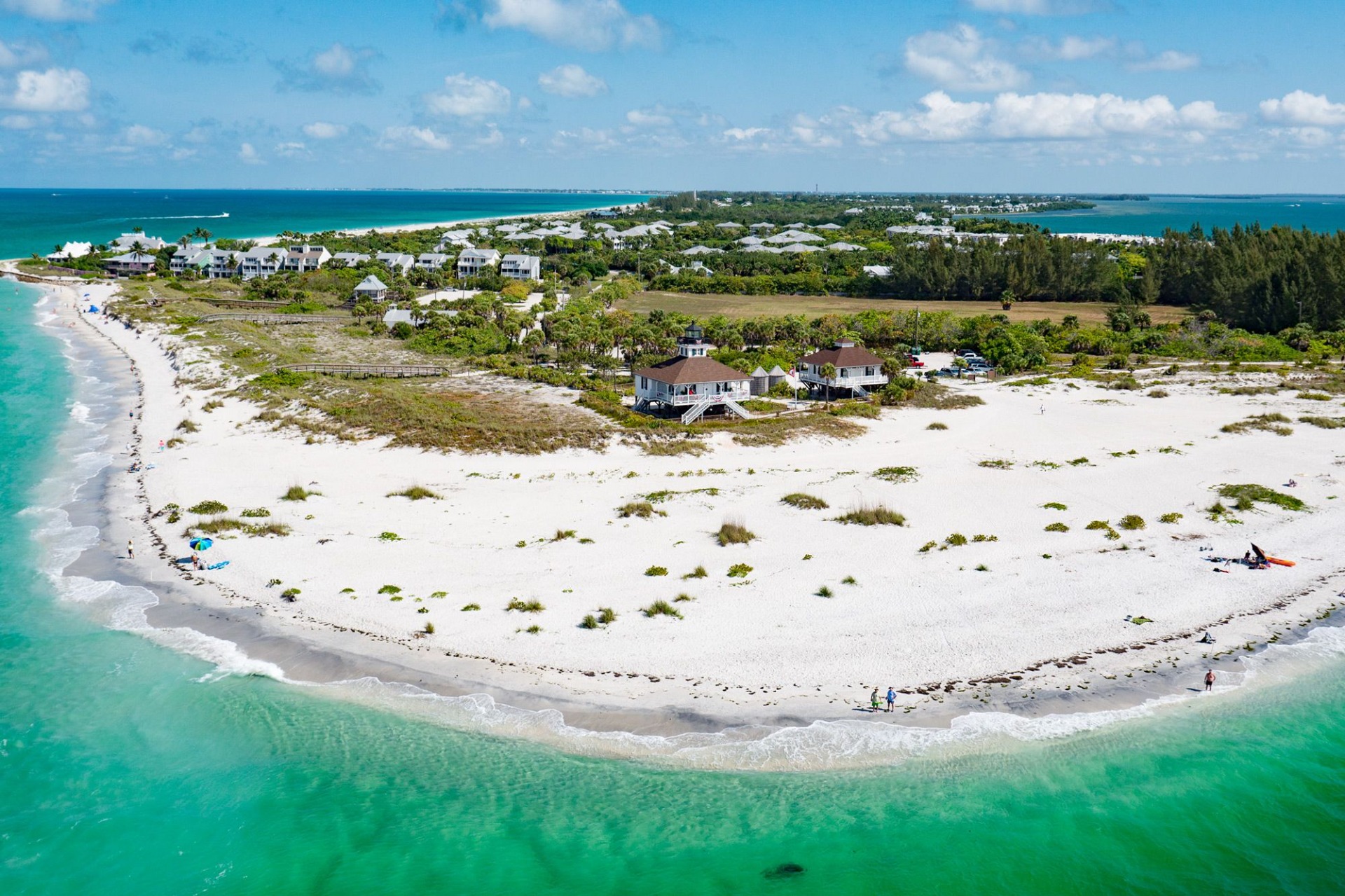
A family beach day on Gasparilla Island works best when everything fits in one load: a soft-sided cooler, a shade structure, towels in a mesh bag, and water. Most beach accesses on the island are modest — expect parking, a boardwalk or dune crossover, and limited or no shade, with restrooms and outdoor rinse showers available mainly at the state park accesses rather than at every crossover. Pack sun protection you can reapply, bring more drinking water than you think you need, and stage gear the night before so the golf cart is loaded in one trip.
The single biggest difference between a good beach day on Gasparilla Island and a rough one isn't the weather. It's how many trips somebody has to make back to the cart. After eighteen years of hosting families, we can usually tell within five minutes of watching a group load up whether they'll be smiling at two o'clock or packing up early with a sunburned kid.
Boca Grande's beaches are gorgeous and refreshingly low-key — which is another way of saying they are not resort beaches. There's no attendant setting up loungers, no snack bar at most accesses, no rental umbrella waiting for you. What you carry across the dune crossover is what you have for the day. So let's make what you carry count.
What the beach accesses actually provide (and what they don't)
Gasparilla Island's shoreline is reached through a series of public accesses, plus the developed accesses inside Gasparilla Island State Park at the south end of the island. They are not all equal, and this is where families get surprised.
- Restrooms and outdoor rinse showers — available at the developed state park beach accesses, not at every neighborhood crossover. If you have small children or anyone who needs a bathroom on short notice, choose a state park access and plan around it.
- Parking — generally small lots or shoulder-style parking rather than large garages. Weekends and holiday weeks fill up first, and the mid-morning window is when spaces disappear.
- Shade — essentially none once you're past the sea grape line. Sun protection is something you bring, not something you find.
- Trash and recycling — bins are usually at the crossover, not down on the sand. Plan to carry your trash back up with you.
- Food and drink — assume nothing on the beach itself. Bring water, and bring more of it than feels reasonable.
If you want the fuller picture of the accesses, the lighthouse, and what a whole day at the south end looks like, we wrote that up separately in our Gasparilla Island State Park guide.
Packing for a golf cart, not a minivan
Most families on Boca Grande get around by golf cart, and a golf cart has roughly one bench of usable cargo room plus whatever laps are free. That constraint is actually a gift — it forces you to pack like someone who has done this before.
The rule we give guests: everything must be soft-sided, stackable, or ridable. Hard coolers are heavy, slide around on turns, and eat the whole back bench. A soft-sided cooler squashes into a corner and carries by strap. Rolling beach carts are wonderful on the sand and terrible in a cart footwell — if you bring one, it goes on last and comes off first.
- One soft-sided cooler with drinks and food, packed the night before and chilled overnight.
- One mesh bag with towels — mesh so the sand falls out instead of coming home with you.
- One dry bag or zip bag with phones, keys, and anything that must not get wet.
- One shade structure — a pop-up sun shelter or beach umbrella with a sand anchor.
- Chairs, strapped together with a bungee so they travel as a single unit.
- A gallon jug of plain water, separate from the cooler, purely for rinsing feet and faces.
If it takes two trips from the cart to the sand, you packed for a house, not a beach.
Before anyone drives, make sure you know who's legally allowed behind the wheel and which streets are open to carts — the rules are stricter than most visitors assume, and we broke them down in Florida golf cart rules for visitors.
The bike-basket version: what to cut
Plenty of families ride the island's bike path instead of driving, and a basket holds maybe a fifth of what a cart does. When you're on two wheels, cut in this order: chairs first (sit on your towel), then the cooler (bring an insulated bottle of water each and eat before or after), then the shade structure if — and only if — you're going early morning or late afternoon when the sun angle is low.
What never gets cut: water, sun protection, and something to carry your trash out in. Everything else is negotiable.
Cooler and sun-protection ground rules
Two categories cause almost all the trouble on a Florida beach day: what's in the cooler and what's on your skin.
On coolers — glass containers are prohibited on Florida state park beaches, and it's a sensible rule to follow at any access, since broken glass in sand is nearly impossible to find. Alcohol is also prohibited in Florida state parks. Pack cans and reusable bottles, freeze half your water bottles to serve as ice, and keep raw and ready-to-eat food separated in a climate where a cooler warms up fast.
On sun — this is the Gulf of Mexico in subtropical Florida, and the light comes at you twice: directly from above and reflected off pale sand and water. Sunscreen applied once at nine in the morning is not protection at one in the afternoon. Bring enough to reapply for everyone, and treat rash guards, wide-brimmed hats, and a shade structure as the primary defense with sunscreen as backup rather than the other way around.
Stage the night before, load in one trip
Here's the part almost nobody does, and it's the whole difference. The night before, put every beach item in one pile by the door — not in bedrooms, not in the kitchen, one pile. Load the cooler with everything except ice. In the morning you add ice, carry the pile out, and go.
Assign jobs while you're at it. One adult carries the cooler and chairs. One adult carries shade and the dry bag. Each kid old enough to walk carries their own towel and their own water bottle — it teaches ownership and it genuinely lightens the adults' load. Nobody gets to arrive empty-handed.
Guests staying at Seaside Boca have a real advantage here, because the whole staging routine works best when you're close enough to the beach that a forgotten item is an annoyance rather than a day-ender. If you're still planning the trip broadly, our Boca Grande family guide covers the rest of the island beyond the sand.
Crossing the dunes without doing damage
Use the marked boardwalks and crossovers every single time, even when the sand looks perfectly walkable on either side. Dune vegetation — sea oats especially — holds the beach together during storms and is protected under Florida law. A shortcut path worn by a few families becomes a channel for storm water, and it doesn't grow back quickly.
This also matters at night. Sea turtles nest on these beaches during the warmer months, and the standard practice is to remove all chairs, umbrellas, tents, and toys from the sand at the end of the day and fill in any holes the kids dug. Flat, clear sand is what a nesting turtle and her hatchlings need. It takes five minutes and it's the right way to leave a beach anyway.
The one-trip checklist
| Cart day | Bike day | |
|---|---|---|
| Water | Gallon jug + bottles | Insulated bottle each |
| Shade | Pop-up shelter + anchor | Hats and rash guards |
| Cooler | Soft-sided, no glass | Skip — eat before or after |
| Seating | Chairs bungeed together | Towel on the sand |
| Sun care | Enough to reapply twice | Enough to reapply once |
| Out | Trash bag + wet-suit bag | Trash bag |
Pack it this way once and your family will pack it this way for the rest of the week. That's the goal — not a perfect first day, but a routine everyone can run on autopilot by Wednesday.
Beach day questions we get asked most
Are there restrooms at the Gasparilla Island beach accesses?
Restrooms and outdoor rinse showers are available at the developed beach accesses within Gasparilla Island State Park, not at every neighborhood crossover along the island. If you're traveling with small children, plan your day around a state park access. Confirm current facility status with the park before you go, since maintenance and storm damage occasionally close them.
Can I bring a cooler with alcohol or glass bottles to the beach?
Glass containers are prohibited on Florida state park beaches, and alcohol is prohibited in Florida state parks. Pack cans and reusable plastic or metal bottles instead. Even at accesses outside the park, leaving glass at home is the sensible call — broken glass in sand is nearly impossible to clean up.
Is there any natural shade on Boca Grande's beaches?
Essentially none once you cross the dune line. Bring your own shade — a pop-up sun shelter or a beach umbrella with a proper sand anchor, since Gulf breezes will take an unanchored umbrella down the beach. Wide-brimmed hats and rash guards do a lot of work too, especially for kids who won't sit under a shelter.
How much can a golf cart realistically carry for a beach day?
Roughly one bench of cargo plus whatever laps are free, which is enough for a family of four to five if everything is soft-sided and stacked. Hard coolers and rigid beach carts eat that space fast. Bungee the chairs together, use a mesh towel bag, and the whole load becomes one trip.
What time should we head to the beach with kids?
Early morning and late afternoon are the most comfortable windows, both for temperature and for parking, which fills up first at mid-morning on weekends and holiday weeks. The EPA identifies roughly 10 a.m. to 4 p.m. as peak UV hours, so if you're out then, treat shade and covering up as your primary protection.
Do we need to take everything off the beach at the end of the day?
Yes — the standard practice during sea turtle nesting season is to remove all chairs, umbrellas, tents, and toys from the sand and fill in any holes that were dug. Flat, clear sand is what nesting turtles and hatchlings need to move safely. It's also simply good beach etiquette year-round.

Travel DRD - Free Land Vacations — IATA certified, IATAN and ASTA members, hosting families since 2007. We manage every home in this collection ourselves.
Last updated: August 7, 2026