
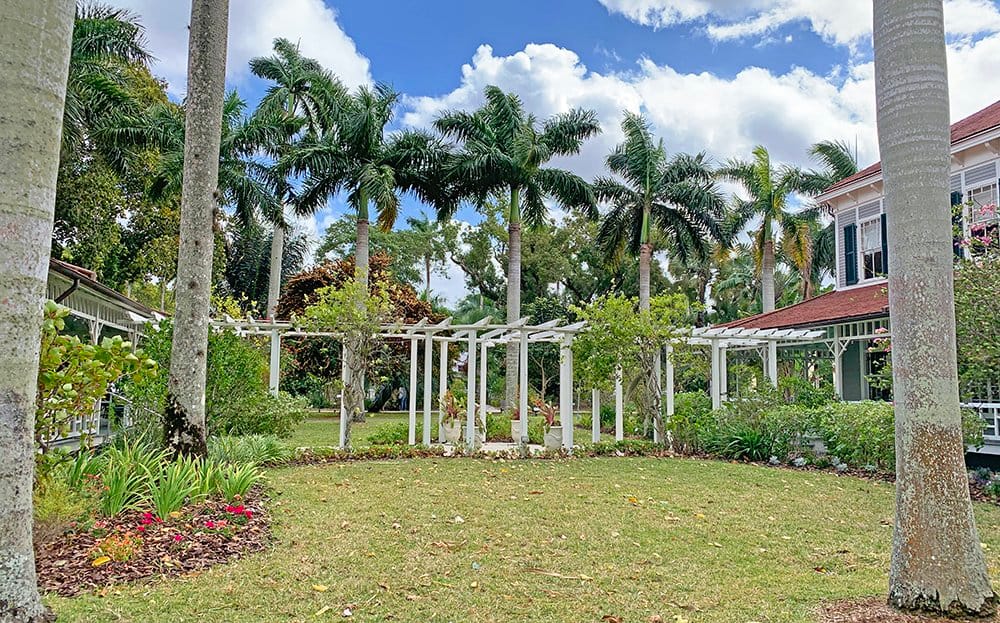
The Edison and Ford Winter Estates in Fort Myers preserves the neighboring winter homes of Thomas Edison and Henry Ford, along with riverside botanical gardens, a museum of inventions, and Edison's botanical research laboratory. Highlights include one of the largest banyan trees in the continental United States and hands-on exhibits that work well for kids. It sits along the Caloosahatchee River on McGregor Boulevard and is an easy half-day outing from Estero, Bonita Springs, and Fort Myers Beach.
When guests ask us for one rainy-morning-proof, grandparents-and-kids-both-happy outing in Fort Myers, this is the answer we give almost every time. The Edison and Ford Winter Estates is where Thomas Edison and Henry Ford — actual next-door neighbors — spent their winters, and the whole riverside property is preserved: two historic homes, acres of botanical gardens, a museum full of inventions, and the laboratory where Edison ran one of his last great research projects.
We've been sending guests there for the better part of two decades, and the feedback is remarkably consistent: people expect a dusty house tour and come back talking about the trees, the lab, and how much their kids got into it. Here's how to do it well from an Estero-area stay.
What the Estates Actually Are
In the 1880s, Edison came to Fort Myers looking for a warm place to spend winters and bought riverfront land on what is now McGregor Boulevard. He built a winter retreat he called Seminole Lodge, planted gardens, and kept coming back for the rest of his life. Henry Ford, a friend and admirer of Edison, later bought the property next door, a home known as The Mangoes. Today both homes, the grounds between them, a museum, and Edison's research laboratory operate together as a single historic site along the Caloosahatchee River.
One thing worth knowing going in: you view the historic homes from their wraparound porches and open doorways rather than walking through the interiors. That sounds like a downside, but the porches were the point of these houses — they were built to catch the river breeze — and the furnishings inside are original or period-accurate, so you're looking at the rooms much as the families used them.
The Banyan Tree and the Gardens
The single most photographed thing on the property is the enormous banyan tree near the entrance. It was a gift from tire magnate Harvey Firestone, planted small in the 1920s, and it has since grown into one of the largest banyan trees in the continental United States — a sprawling canopy held up by a forest of its own aerial roots. Kids who have zero interest in Victorian furniture will happily spend a long time just staring at it.
The rest of the grounds are a working botanical collection, not just landscaping. Edison planted much of it for research purposes — he was hunting for plants that could yield useful materials — so you'll find champion trees, old-growth tropical specimens, orchids, and a riverside stretch of royal palms. The gardens alone justify the visit for anyone who likes plants, and the river views from the seawall are genuinely lovely in the late afternoon.
The Laboratory and Museum: Where It Gets Interesting
Here's the part most visitors don't know. Late in his life, Edison — backed by Ford and Firestone — set up the Edison Botanic Research Corporation to find a domestic source of natural rubber, because the United States depended on imported rubber and the three of them saw that as a national vulnerability. The laboratory on the property is where that research happened, with Edison's team testing thousands of plants; goldenrod turned out to be the most promising. The lab is preserved with its original equipment and has been recognized as a National Historic Chemical Landmark.
The museum across the way holds an extensive collection of Edison inventions and artifacts — phonographs, early light bulbs, movie equipment, Ford vehicles — plus exhibits about both men's lives. It's air-conditioned, which matters more than you'd think in a Florida summer, and it's the natural second half of the visit after you've walked the grounds.
Does It Work With Kids? Honestly, Yes
We host a lot of multigenerational families, and this is one of the few historic sites where the kids don't need to be bribed. A few reasons it works:
- The banyan tree reads like a climbing structure from a storybook (climbing isn't allowed, but circling it and counting root trunks becomes its own game).
- The story is concrete: light bulbs, phonographs, cars, and a real laboratory beat abstract history every time.
- It's mostly outdoors, so restless kids can move — this is a stroll, not a hushed museum shuffle.
- Audio and guided tour options let adults go deep while kids go at their own pace.
- The whole visit fits in a half day, which is about the honest attention span of a family on vacation.
Two of the most famous men in American history chose this river for the same reason you did — winter here is worth the trip.
How Long to Plan and When to Go
Plan on two to three hours for a relaxed self-guided visit — longer if you take a guided tour or your group includes a serious garden person. Mornings are the comfortable play in warm months, both for heat and for softer light under the banyan. In winter season the site draws steady crowds, so earlier in the day is also quieter. Most of the route is unshaded-to-partly-shaded walking on flat ground, so hats, water, and sunscreen are the usual Florida rules.
If you're structuring a week, this pairs naturally with a nature day elsewhere — a lot of our guests do the estates one morning and Myakka River State Park another day for the alligators and canopy walk, which gives you one history day and one wild-Florida day without repeating yourself.
Getting There From an Estero-Area Stay
From Estero, the estates are an easy drive north — up U.S. 41 or I-75 toward downtown Fort Myers, then over to McGregor Boulevard, the royal-palm-lined street that Edison himself helped popularize. Guests staying at our Estero Escape home typically make a morning of it and are back at the pool by mid-afternoon. Traffic on 41 builds in winter season, so leaving earlier keeps the drive painless.
It also slots neatly into a bigger Southwest Florida loop. If you're exploring the quieter mainland stretches, our Port Charlotte and Cape Haze guide covers the coast north of here, and if you want a water day to balance the history day, our guide to renting a boat in Southwest Florida walks through how to do that without wasting a vacation morning on logistics.
A Few Tips From Years of Sending Guests
- Do the grounds first and the museum second — you'll want the air conditioning as a finale, not an opener.
- Stand under the banyan and look up before you read any signage; the scale lands better without preamble.
- Don't skip the laboratory because it looks small. It's the most surprising room on the property and the part adults talk about afterward.
- Garden lovers should ask about the plant collection — the site also periodically sells plants propagated on the grounds.
- Check the calendar before you go; the estates run seasonal events and specialty tours that can be worth planning around.
Questions Guests Ask Us About the Edison and Ford Estates
Can you go inside the Edison and Ford homes?
The historic homes are viewed from their porches and open doorways rather than by walking through the interiors. The rooms are furnished with original and period pieces, so you see them essentially as the families lived in them, and the porches themselves — built for the river breeze — are a highlight.
How much time should a family plan for the Edison and Ford Winter Estates?
Two to three hours covers the grounds, both home exteriors, the laboratory, and the museum at a comfortable family pace. Add time if you book a guided tour or have a dedicated garden lover in the group. It works well as a morning outing with the afternoon left free.
What is the big tree at the Edison estate?
It's a banyan tree, given to Edison by Harvey Firestone and planted in the 1920s, when it was small. It has grown into one of the largest banyans in the continental United States, spreading on a network of aerial roots, and it's the most photographed spot on the property.
Why did Edison have a laboratory in Fort Myers?
In his later years, Edison partnered with Henry Ford and Harvey Firestone to search for a domestic source of natural rubber, since the U.S. relied on imports. His Fort Myers laboratory tested thousands of plants, with goldenrod emerging as the most promising, and the preserved lab is now a National Historic Chemical Landmark.
Is the visit mostly indoors or outdoors?
Mostly outdoors — the gardens, riverfront, and home exteriors are open-air walking on flat ground, while the museum and laboratory portions are indoors. Bring hats, water, and sunscreen in warm months, and plan the air-conditioned museum as the finish rather than the start.
How far are the estates from Estero and Bonita Springs?
The estates sit on McGregor Boulevard near downtown Fort Myers, an easy drive north from Estero and Bonita Springs via U.S. 41 or I-75. Most of our guests treat it as a half-day trip and are back at the house by mid-afternoon, though winter-season traffic makes an earlier start smoother.

Travel DRD - Free Land Vacations — IATA certified, IATAN and ASTA members, hosting families since 2007. We manage every home in this collection ourselves.
Last updated: July 24, 2026