
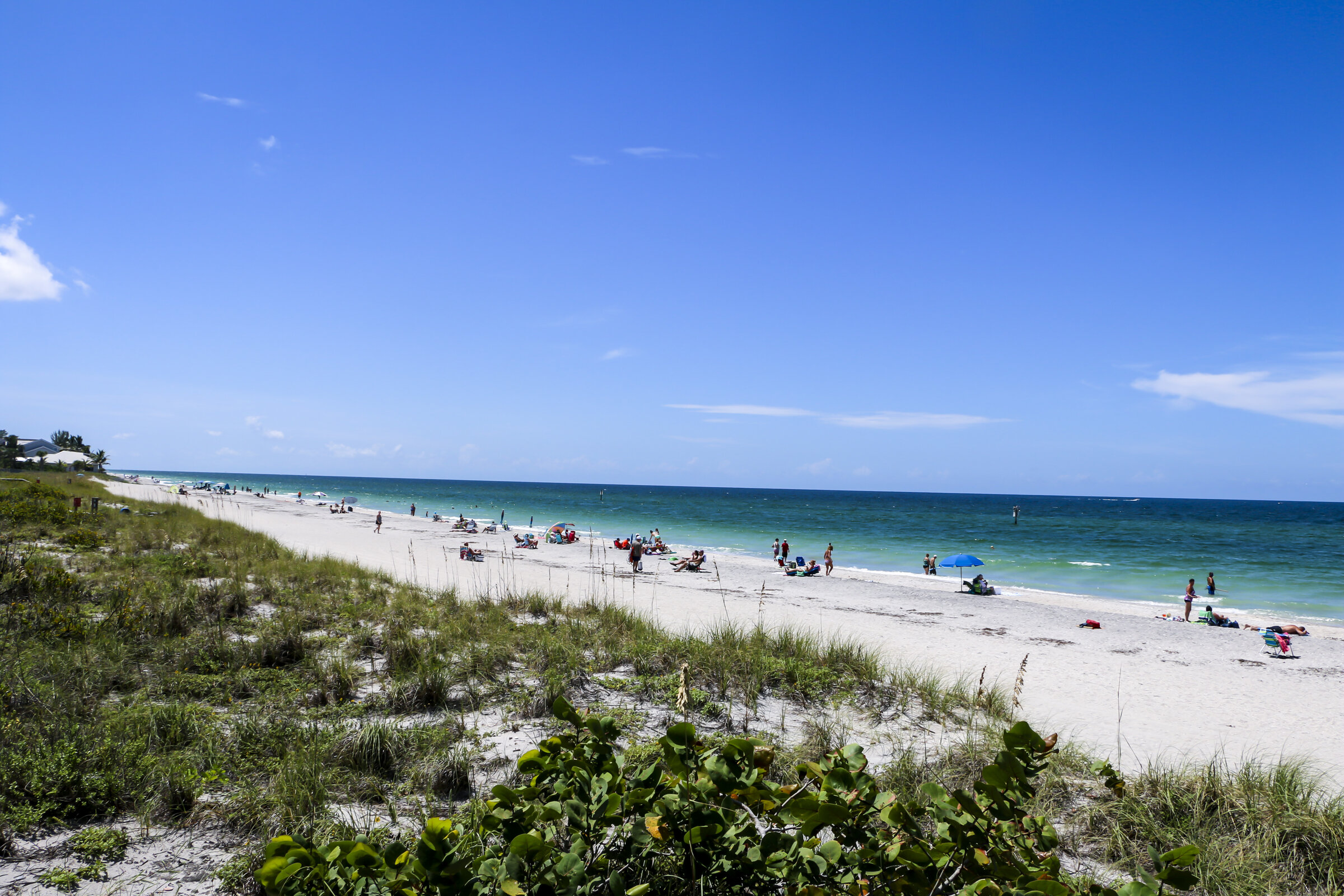
Manasota Key is a narrow, mostly low-rise barrier island straddling the Sarasota-Charlotte county line, just north of Boca Grande and Gasparilla Island. It has three main public beach access points — Manasota Beach Park, Blind Pass Beach, and Chadwick Park at Englewood Beach — a strong reputation for fossilized shark tooth hunting, and one of the Gulf coast's busiest loggerhead sea turtle nesting beaches, May through October.
Everyone who books a Boca Grande trip eventually notices the island directly north of it on the map and asks the same question: what's that one? That's Manasota Key — an 11-mile barrier island straddling the line between Sarasota County to the north and Charlotte County to the south, connected to the mainland by two small bridges instead of one causeway, and built almost entirely low-rise. No high-rises, no bridge traffic to a village center, no lighthouse. Just beach.
That plainness is the whole appeal. Manasota Key doesn't have Boca Grande's shops or its Old Florida village charm, and it isn't trying to. What it has instead is three real public beach parks, a shoreline that turns up fossilized shark teeth on an ordinary afternoon, and a nesting beach that loggerhead sea turtles use in some of the highest numbers on the entire Gulf coast. It's a short drive from Seaside Boca in Placida, and for families who've already done Boca Grande and Englewood Beach, it's the next place worth a morning.
Where is Manasota Key, exactly?
Manasota Key runs roughly north-south, separated from the mainland by Lemon Bay. The northern half sits in Sarasota County near Venice; the southern half sits in Charlotte County near Englewood. Two bridges connect it to the mainland — one at the north end near Venice, one at the south end at Englewood — rather than a single entry point, which spreads traffic out and keeps the island from ever feeling like a bottleneck the way a single-causeway island can.
From Placida, it's a short drive north along the coast — closer than Sanibel or Captiva, and a genuinely easy add-on to a Boca Grande-based trip rather than a separate excursion. Families staying at Seaside Boca who've already walked Boca Grande Beach and Englewood Beach at Chadwick Park often use Manasota Key's quieter access points — Blind Pass and Manasota Beach Park — as the next beach day, precisely because they're less crowded than the two better-known options nearby.
What are the actual beach access points?
This is the detail that trips people up: Manasota Key is mostly private residential frontage, so public beach access is concentrated at a small number of named parks rather than spread continuously along the island. Three matter most for a family day trip.
- Manasota Beach Park — the Sarasota County park at the north end, with a beach, pavilions, picnic tables, restrooms, a lifeguard station, outdoor showers, and free parking. It also has a boat ramp, which makes it a real launch point, not just a beach.
- Blind Pass Beach (also called Middle Beach) — the quiet, nature-trail option roughly mid-island, known for a boardwalk through native scrub, fewer crowds, and a more secluded feel. It's the pick for a slower morning without a playground or a crowd.
- Chadwick Park at Englewood Beach — the busiest and most built-out of the three, at the south end of Manasota Key in Charlotte County: shaded playground, sports courts, picnic pavilions, restrooms, and a metered parking lot. We cover this one in detail in our Englewood Beach vs. Boca Grande Beach comparison — the two aren't the same place, even though Chadwick Park sits on Manasota Key.
That last point is worth being precise about, because it's a common mix-up: Englewood Beach is a specific park on the south end of Manasota Key, not a separate island. If you've read our Englewood-vs-Boca-Grande comparison, you've already seen one corner of Manasota Key. This post is about the rest of it.
Manasota Key doesn't have Boca Grande's shops or its Old Florida village charm, and it isn't trying to. What it has instead is a shoreline that turns up fossilized shark teeth on an ordinary afternoon.
Is Manasota Key really good for shark tooth hunting?
Yes, and it's not a minor claim — this stretch of Charlotte and Sarasota county coastline, running from Casey Key and Venice south through Manasota Key, sits over an unusually rich deposit of fossilized shark teeth eroding out of an offshore geologic layer. Venice gets the "Shark Tooth Capital of the World" branding, but Manasota Key shares the same fossil bed and draws serious, repeat collectors specifically because it hasn't been as heavily marketed or crowded as Venice's beaches.
The method is simple and works for almost any age: walk the tide line, especially right after a storm has churned the nearshore sand, and look for small black or gray triangular shapes mixed in with shell fragments. A mesh sifting scoop or a kitchen sieve makes the search faster than eyes alone, and low tide in the early morning is the reliable window before foot traffic disturbs the wrack line. Guided eco-tours and equipment rentals are available on the island for families who want a local's eye on their first outing.
How big a deal is sea turtle nesting on Manasota Key?
This is Manasota Key's most serious identity, and it's worth families knowing before they visit in summer. The Coastal Wildlife Club — a volunteer nonprofit that has patrolled these beaches since 1985 — documents sea turtle nesting activity daily across Manasota Key's Sarasota and Charlotte county sections during nesting season, and this stretch of beach ranks among the highest-density nesting beaches on Florida's entire Gulf coast for loggerhead sea turtles, a species federally protected as threatened.
Florida's official sea turtle nesting season runs May 1 through October 31, with the heaviest nesting and hatching activity concentrated from late May through early September. Loggerheads are the species you'll hear about most here — they account for the large majority of nests on this coast — though green sea turtles and, less often, Kemp's ridleys also nest on Gulf coast beaches.
The practical rules for anyone on the beach during nesting season are the same as anywhere else on this coast: keep lights off the sand at night (artificial light disorients nesting females and hatchlings), fill in any holes dug during the day before you leave, take chairs and other equipment off the beach after dark, and never touch, dig around, or shine a light directly at a nest or a nesting turtle. If you see someone disturbing a nest or a turtle, the right move is to call FWC's Wildlife Alert hotline or the local sheriff's office — not to intervene yourself.
How is Manasota Key different from Boca Grande?
| Manasota Key | Boca Grande / Gasparilla Island | |
|---|---|---|
| Character | Low-rise, residential, quiet | Historic village, shops, lighthouse |
| Access | Two bridges (Venice north end, Englewood south end) | One toll causeway from Placida |
| Public beach access | A handful of named parks (Manasota Beach Park, Blind Pass, Chadwick Park) | Mostly inside Gasparilla Island State Park |
| Known for | Shark teeth, sea turtle nesting, quiet | Tarpon fishing, the lighthouse, shelling |
| Dining/shopping | Minimal — mostly Englewood's mainland side | Walkable village with restaurants and shops |
Neither island is "better" in an absolute sense — they're different tools for different days. Boca Grande gives you a destination day: the lighthouse, the bike path, lunch at the Pink Pony, a reason to spend six hours. Manasota Key gives you a beach morning: park, walk, hunt for teeth or watch for nesting signs, and leave before lunch. Families staying multiple nights in the area tend to use both — a Boca Grande day and a Manasota Key morning — rather than picking one over the other.
What should we actually know before we go?
Parking at Manasota Beach Park and Blind Pass Beach is free but limited, and both fill up on weekends and holidays in season — arrive early rather than mid-morning. Chadwick Park at Englewood Beach runs metered parking through the ParkMobile app. None of the three access points has a resort-style boardwalk or concessions the way a built-up beach town does; bring your own water, shade, and snacks. Restrooms exist at all three but facilities are basic rather than elaborate.
Cell service and navigation apps sometimes route visitors to residential streets rather than the actual park entrances, since Manasota Key Road runs the length of the island past private driveways. Search for the park by name, not just "Manasota Key," and follow the county park signage rather than a generic pin.
Where do you stay to make Manasota Key part of the trip?
Manasota Key itself has limited lodging inventory built for large families — it's a residential island, not a resort strip. The practical base is the same one that works for Boca Grande: the Placida and Cape Haze mainland, a short drive south. Seaside Boca, our Key West-style home in Placida, sleeps 10 across 3 bedrooms plus a bunk room and 3.5 baths, with a resort-style pool, hot tub, infrared sauna, private mini golf, volleyball and soccer courts, a game room, fire pit, and dock access. It puts a family within easy reach of Boca Grande one day and Manasota Key's quieter beaches the next, without committing to island-only lodging on either end.
For the wider mainland picture — groceries, the airport, why Placida makes more sense than the island itself — see our Port Charlotte, Placida and Cape Haze guide. And if the beach comparison is still the open question, our Englewood Beach vs. Boca Grande Beach post covers the two most family-equipped options on this stretch of coast in more depth.
Manasota Key questions families ask
Is Manasota Key the same as Englewood Beach?
Not exactly. Englewood Beach — officially Chadwick Park at Englewood Beach — is one specific public beach park at the south end of Manasota Key, in Charlotte County. Manasota Key is the whole 11-mile barrier island, with two other public access points further north: Manasota Beach Park and Blind Pass Beach.
Is Manasota Key good for finding shark teeth?
Yes. Manasota Key sits over the same rich fossil shark tooth deposit as nearby Venice, and it's a well-known spot among serious collectors, partly because it draws fewer crowds than Venice's more heavily marketed beaches. Walk the tide line at low tide, especially after storms, with a mesh sifting scoop.
When is sea turtle nesting season on Manasota Key?
Florida's official sea turtle nesting season runs May 1 through October 31, with the heaviest nesting and hatching activity from late May through early September. Manasota Key ranks among the busier loggerhead sea turtle nesting beaches on Florida's Gulf coast, monitored daily in-season by the Coastal Wildlife Club.
How far is Manasota Key from Boca Grande?
It's a short drive — roughly 20 to 30 minutes depending on where on Manasota Key you're headed — making it realistic to combine a Boca Grande day with a Manasota Key morning on the same trip, or on back-to-back days of a longer stay.
Is there free parking on Manasota Key?
Manasota Beach Park and Blind Pass Beach both offer free parking, though lots are limited and fill on weekends and holidays. Chadwick Park at Englewood Beach, on the island's south end, uses metered parking through the ParkMobile app.

Travel DRD - Free Land Vacations — IATA certified, IATAN and ASTA members, hosting families since 2007. We manage every home in this collection ourselves.
Last updated: July 22, 2026