
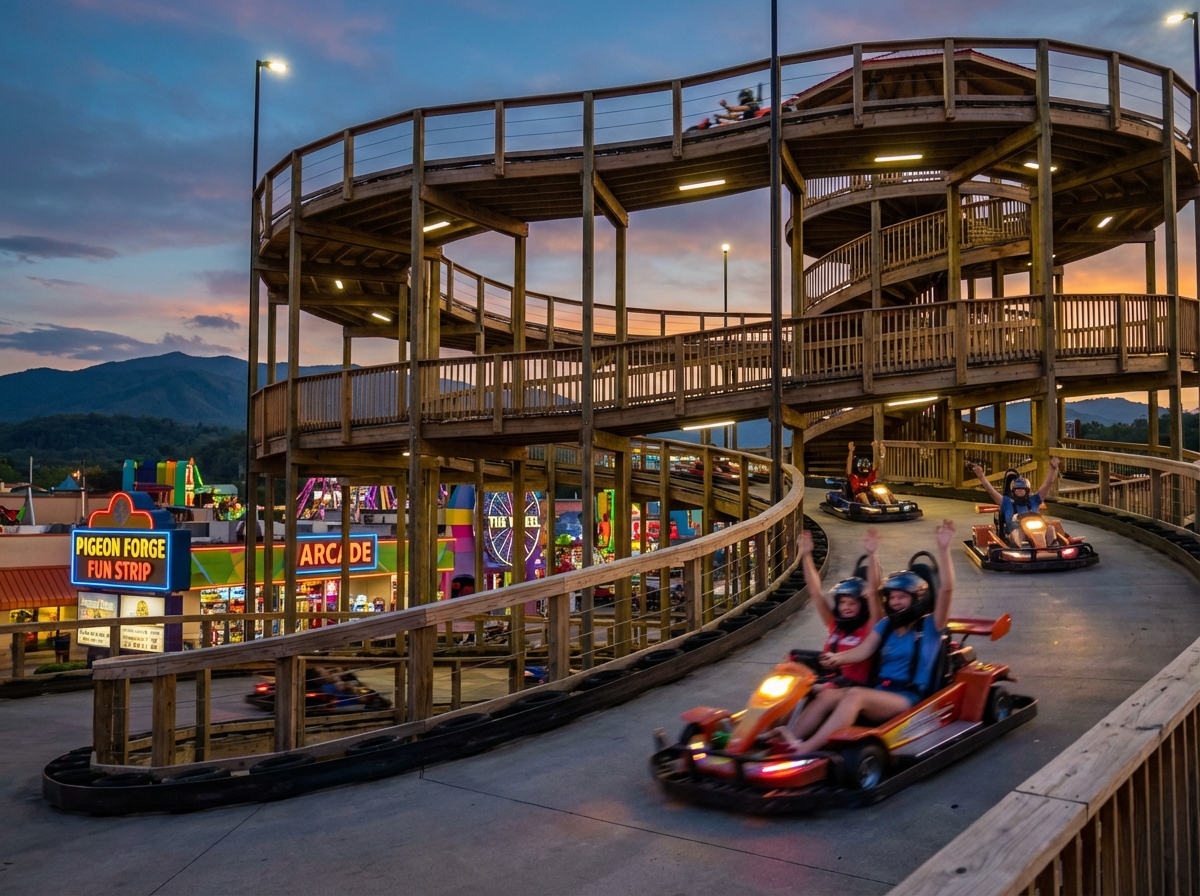
The Pigeon Forge Parkway is a roughly five-mile commercial strip lined with go-kart tracks, mini golf courses, arcades, dinner theaters and family attractions. Locals and businesses navigate it by numbered traffic lights, which are used like address markers. The practical approach for families is to cluster attractions near one or two traffic lights, park once and walk or ride the local trolley, and pair Parkway time with quieter mornings in Great Smoky Mountains National Park, which sits just south through Gatlinburg.
The first time most families drive into Pigeon Forge, the reaction is the same: eyes wide, then slightly overwhelmed. The Parkway is about five miles of go-kart tracks stacked on hillsides, mini golf courses with waterfalls, pancake houses, arcades, dinner theaters and enough neon to light a small city. Kids see it and want all of it. Parents see it and start doing math.
We've hosted guests in this area long enough to watch the same pattern play out. The families who love the Parkway are the ones who treat it as one deliberate block of the trip — not as the trip. The families who leave exhausted are the ones who tried to drive its full length four times a day. Here's how to be the first kind.
First, understand the traffic lights (they're addresses)
This is the single most useful thing to learn before you arrive. Pigeon Forge numbers its Parkway traffic lights, and businesses genuinely advertise themselves by light number — "at traffic light 6," "just past light 10." Locals give directions that way too. Once you start thinking in light numbers instead of street addresses, the strip stops feeling like a blur and starts feeling like a map with roughly a dozen labeled stops.
Practical use: before you leave the house each morning, write down the light number for everything you want to do that day. If your list spans lights 1 through 10, you've built yourself a traffic problem. If it clusters around two or three adjacent lights, you've built a good day.
The Parkway rewards families who park once and walk, and punishes families who drive between every stop.
Go-karts and mini golf: how to pick, not just show up
Pigeon Forge has one of the densest concentrations of go-kart tracks anywhere in the country, and they are not interchangeable. The differences that actually matter to a family are height and age requirements, whether the track offers two-seat karts so a parent can ride with a younger child, and whether the track is a flat oval or an elevated multi-level course. That last one matters more than people expect — the tall, spiraling wooden tracks look incredible and are a genuine thrill for a confident ten-year-old, and are also the fastest way to find out your six-year-old is not ready.
- Check the height minimum for drivers and for passengers separately — they're usually different numbers, and the passenger minimum is what determines whether your youngest can ride at all.
- Look for tracks advertising two-seat or tandem karts if you're traveling with kids under about eight.
- Ask whether laps are timed or counted. Both exist, and it changes how long you'll actually be standing at the rail.
- Mini golf ranges from short, flat, genuinely toddler-friendly courses to elaborate 36-hole layouts with stairs and elevation. If someone in your group has knee trouble or you're pushing a stroller, ask before you pay.
- Evening is cooler and better lit for photos, but lines are longest between dinner and about an hour after dark.
Arcades, indoor attractions and the rainy-afternoon plan
Every family visiting the Smokies eventually gets a rainy afternoon — summer storms roll through the mountains regularly, often building in the afternoon and clearing by evening. The Parkway is, functionally, the region's rain plan. Arcades, mirror mazes, indoor ropes courses, museums, escape-room style attractions and theaters are all clustered along it, and most take walk-ups.
The trap is the card-swipe arcade. Load a modest amount, tell the kids that's the budget, and mean it — refills are frictionless by design. If you'd rather spend a rainy block on something with more substance, the aquarium in neighboring Gatlinburg holds up better than most indoor options; we wrote up which parts are worth your time in our guide to Ripley's Aquarium of the Smokies with kids.
How to actually pace a Parkway day
The rhythm that works, over and over, for families with kids roughly five to twelve:
- Morning in the mountains or at the cabin. Cool air, no crowds, everybody fresh.
- Early lunch, before the noon rush hits the pancake houses and barbecue places.
- One anchor attraction in the early afternoon — the thing the kids have been asking about.
- A deliberate break. Back to the cabin, or a shaded picnic area. This is the step families skip and regret.
- Return in the evening for lights, one go-kart run and mini golf, then leave before the meltdown, not after it.
Two attractions in a day is a good day. Three is ambitious. Four is how you end up with a car full of crying people and a photo roll nobody wants to look at.
Parking, traffic and the Fun Time Trolley
Most Parkway attractions have their own free lots, so parking itself is rarely the problem — re-entering Parkway traffic is. Turning left across the strip in the evening can cost you real minutes, and the same drive that took eight minutes at nine in the morning can take three times that at seven at night, particularly during summer and during large events, when the strip fills with visitors and traffic slows to a crawl.
Pigeon Forge operates its own trolley system, the Fun Time Trolley, with routes running the Parkway and connecting to neighboring areas. Fares are low, and it's one of the few genuinely good deals in a tourist town. If your lodging is on or near a trolley route, using it for an evening on the strip means nobody circles a lot and nobody drives home tired in heavy traffic. Routes and operating seasons change, so check the current schedule with the city before you plan around it.
Balancing the neon with the quiet
Here's the honest part. The Parkway is fun, and it is also loud, commercial and relentless. The mountains are the reason this valley exists, and they are a short drive south. A morning on a quiet trail, an hour at a creek, or a slow drive on a scenic loop resets a family in a way another arcade never will. We laid out the full trade-off — what the strip does well, what the park does better, and how to split your days — in our Pigeon Forge and Great Smoky Mountains family guide.
This is also where lodging quietly decides your trip. Staying in a cabin set back in the hills, like Pigeon Hills, means the drive home from the strip ends in porch quiet and tree frogs instead of more parking lot. Our guests consistently tell us the afternoon break at the cabin is what made the evening on the Parkway enjoyable rather than exhausting.
What we'd tell a first-time family
Pick two Parkway evenings for a week-long stay, not seven. Cluster by traffic light. Eat before the crowd. Keep a rain plan in your back pocket. And if a theme park day is on your list, plan it as its own full day rather than bolting it onto a Parkway afternoon — our Dollywood planning guide covers how to structure that one so nobody melts down.
The families who come back year after year aren't the ones who did the most. They're the ones who did a handful of things well, unhurried, and still had energy left to sit outside at the end of the night.
Common questions about the Pigeon Forge Parkway
How long is the Pigeon Forge Parkway and how do I navigate it?
The main commercial stretch runs roughly five miles through town. Businesses and locals identify locations by numbered traffic lights rather than street addresses, so noting the light number for each place you want to visit is the fastest way to orient yourself. Grouping your day around one or two adjacent lights saves significant driving.
What age do kids need to be to drive a go-kart in Pigeon Forge?
Requirements vary by track and are based on height as well as age, with separate minimums for drivers and for passengers. Many tracks offer two-seat karts so an adult can ride with a younger child. Check the specific track's posted requirements before you buy, since they are not standardized across the strip.
Is there public transportation along the Parkway?
Yes. Pigeon Forge runs the Fun Time Trolley, with routes serving the Parkway and connecting areas. Fares are inexpensive, and using it for an evening out means avoiding left turns across heavy Parkway traffic. Routes and operating seasons vary, so confirm the current schedule with the city.
When is Parkway traffic worst?
Evenings during peak summer and during major events are the slowest, particularly the window from dinnertime through a couple of hours after dark. Mornings are consistently the easiest time to move around town, which is one reason we suggest mountain time early and strip time later.
What should we do on the Parkway if it rains?
The strip is the region's built-in rain plan: arcades, indoor ropes courses, mirror mazes, museums and theaters are clustered along it and generally take walk-ups. Afternoon storms in the Smokies often clear by evening, so a rainy midday indoors frequently still leaves you an open evening.
How many Parkway attractions can a family realistically do in one day?
Two is a comfortable day for most families with young children, three is ambitious, and four usually ends badly. Building in a genuine break back at your lodging between the afternoon and evening blocks does more for the day than squeezing in one more stop.

Travel DRD - Free Land Vacations — IATA certified, IATAN and ASTA members, hosting families since 2007. We manage every home in this collection ourselves.
Last updated: July 31, 2026